REVIEW · SANTIAGO
Half Day Santiago City Tour
Book on Viator →Operated by Go2Chile Travel · Bookable on Viator
Santiago can feel big on day one, but this half-day tour gives you a smart route through the city’s layers. You start with the historic core and major landmarks, then you switch gears to modern neighborhoods and a relaxed park break in Vitacura. Hotel pickup and a small group (max 15) make it easier to ask questions and actually follow the story as the minivan moves you around.
Two things I really like: the tour feels well-paced for a half day (you get time at key stops, not just photo stops), and the guide narration helps you connect old Santiago to the modern city you’re seeing from the window. A small but important consideration: this is a shared, bilingual-style experience, so if your language preference is strict—or you hate any waiting around—go in with realistic expectations and confirm what language you’ll hear.
In This Review
- Key Things to Know Before You Go
- Getting Oriented in Santiago Fast: Old Center to the Modern East
- Plaza de Armas: Catedral, City Hall, and the Main Square Feel
- Santa Lucía Hill: Panoramas from the Historic Fortress Park
- Club Hípico de Santiago: A Short, Local-Color Stop
- La Moneda and the Guard Change: Politics Up Close in White Neoclassical
- The Minivan Ride-by Tour: Markets, Universities, Churches, and Neighborhood Mood
- Parque Bicentenario in Vitacura: Swans, Ducks, and a Calm Ending
- Price and Value: Is $75 a Smart Buy for 4.5 Hours?
- Shared Tour Reality: Language, Timing, and How to Make It Better
- Should You Book This Half-Day Santiago City Tour?
Key Things to Know Before You Go
- Small-group size (max 15) keeps the tour from feeling like a cattle call.
- Air-conditioned minivan + hotel pickup/drop-off saves you the hassle of figuring out local transport.
- Landmark-focused route: Plaza de Armas, Santa Lucía, Club Hípico, La Moneda, then Vitacura.
- Guard change timing isn’t daily—the presidential guard change happens every 48 hours.
- All the listed stops have free admission (no ticket cost surprises), but lunch is not included.
Getting Oriented in Santiago Fast: Old Center to the Modern East
This tour works best as your first taste of Santiago—especially if you want to build a mental map. You begin in the city’s historic core with that classic Chilean mix: older neighborhoods, institutional buildings, and a lot of people-watching. Then you shift outward to newer areas like Providencia, Las Condes, and Vitacura, which is where the city’s current “where things happen” energy comes through.
Because you’re traveling by comfortable minivan, you don’t spend the entire morning stuck on the sidewalk. The route also keeps your effort reasonable for a half-day: you’ll walk and stand at several viewpoints and plaza areas, but it’s not a full-on marathon.
It helps that the tour is narrated end to end. Whether you’re drawn to politics, architecture, or everyday street life, the commentary is there to connect the dots—like explaining why La Moneda looks the way it does, or what you’re seeing when you pass major university buildings, cultural centers, and markets.
One more practical note: the tour starts early at 8:30am, and pick-up timing is confirmed the day before by email. If you’re staying outside the central zone, you’ll want to double-check your pickup spot and timing so you’re not sprinting to the lobby.
You can also read our reviews of more city tours in Santiago



Plaza de Armas: Catedral, City Hall, and the Main Square Feel
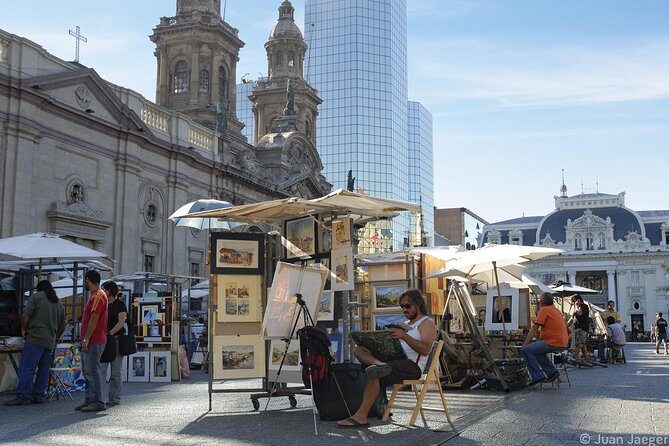
Plaza de Armas is the kind of place where Santiago’s history stacks up in plain sight. You’ll spend about 30 minutes in the main square area, with time to see the Metropolitan Catedral, Santiago City Hall, the Main Post Office, and nearby major institutions like the national historic museum.
Why this stop matters: it’s the easiest “anchor point” for understanding the city. If you later navigate on your own, you’ll recognize the square area and immediately understand why so many other sights orbit around it.
Also, this is a great place for slow observation. You’ll see the rhythms of morning foot traffic—locals moving through daily routines, not just tour photos. And if you like architecture, you’ll get that official, civic feeling right away: stone, scale, and the sense that this is the city’s long-time center.
The only catch is that plaza time can vary in real life depending on crowds and where you’re standing for photos. Still, the listed time is enough to get your bearings without turning it into a rush.
Santa Lucía Hill: Panoramas from the Historic Fortress Park
Next up is Cerro Santa Lucía, entered through the Santa Lucía Metropolitan Park. You’ll get about 30 minutes here, including the fortress-style area that traces back to the Spaniards.
This stop is mostly about views and mood. Even if you don’t go super deep into every corner, you’ll understand why Santiago likes to “show off” its vantage points. You’ll get a high-location feel for how the city spreads out—historic areas below, then newer districts stretching further.
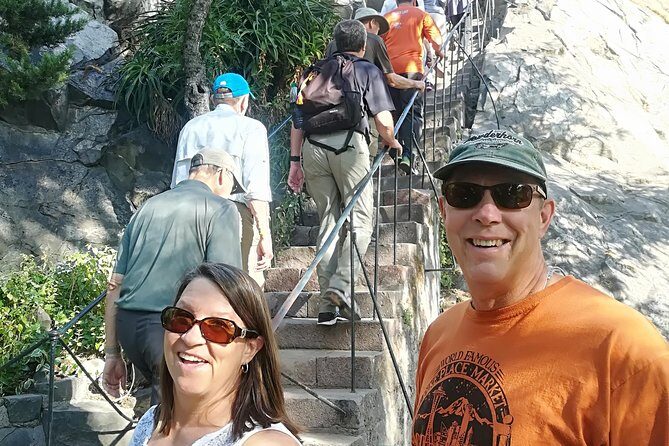
There’s also a practical lesson here: expect some uneven ground and climbing. Comfortable shoes are not optional for this one. One added consideration from real-world experience is that you might be asked to pay separately if you want to use a funicular option to get up or back down faster. If you’d rather walk, you can—just plan to take your time.
The good news is that you don’t need half a day for this. The time window is tight enough to keep the day moving, but it’s long enough to enjoy the park atmosphere without rushing through it.
Club Hípico de Santiago: A Short, Local-Color Stop
You’ll stop at Club Hipico de Santiago for around 20 minutes. This isn’t a long museum visit—it’s more of a quick look at the jockey club and the racing track environment, including a glance at horses training.
Why it’s worth it (even if you’re not a racing fan): it adds a different side of Santiago to the morning. Most city tours focus on plazas and government buildings. This one throws in something more local and grounded in routine—people, horses, and training schedules that feel like part of everyday Chilean life.
The drawback is simple: it’s short. If you want deep access—behind-the-scenes, longer track viewing, or more time with the horses—you won’t get that in this format. Still, as a “cultural texture” stop, it works.
La Moneda and the Guard Change: Politics Up Close in White Neoclassical
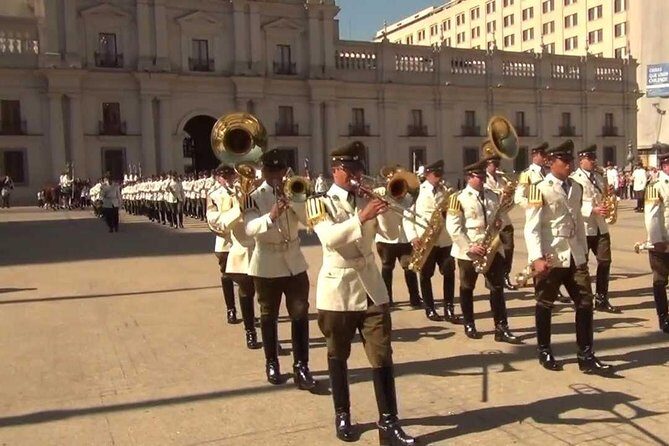
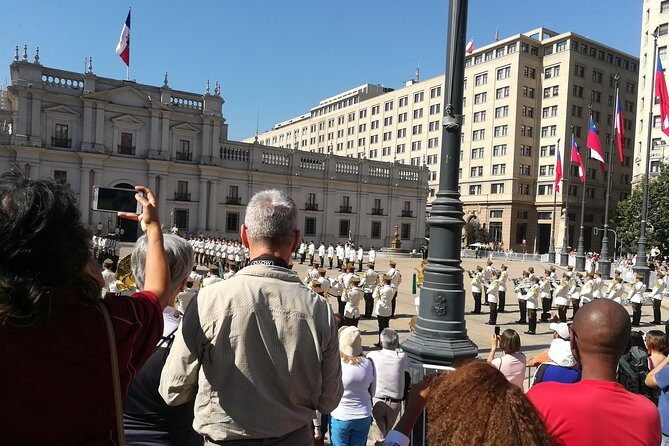
La Moneda is the headline stop for many people. You’ll see the outside of the presidential palace and nearby government/ministry buildings, with time that includes the changing of the presidential guard when it’s scheduled.
The big detail you should plan around: the guard change happens every 48 hours, not daily. So on some days it’ll be a direct highlight; on other days you’ll still see the palace exterior and government area, but the exact moment you’re hoping for may not align.
This is also one of the best “learning stops” on the tour because the building itself carries layers—from its earlier history through its modern role. Even just watching the formal rhythm of security and ceremonial movements helps you understand why La Moneda sits so centrally in Chile’s public life.
Note how this stop feels in practice: it’s partly visual (architecture, flags, government block scale) and partly observational (crowds, timing, watching the guard routine). If you’re someone who likes to be early and settle in, arrive with that mindset. If you prefer movement and photos, you’ll still have enough time to capture what you came for.




The Minivan Ride-by Tour: Markets, Universities, Churches, and Neighborhood Mood
Between the big stops, the tour uses the minivan to cover a lot of ground efficiently. This is where you get a fast education in how Santiago is organized—what looks “official” versus what looks everyday, and how different neighborhoods shift in tone as you move.
You’ll drive past several major landmarks, including:
- the National Library
- the Cultural Center Gabriela Mistral
- major university buildings (including the main house of the Catholic University and the University of Chile)
- the San Francisco Church
- the Old Men’s Club La Unión
- and views toward the San Cristóbal Hill area and Pablo Neruda’s museum (not as an entry stop, more as pass-by context)
You’ll also pass through market zones like the Central Market, known for fish and seafood, and the fruit and vegetable market. If markets are your thing, this is a good way to spot where you’d want to return later on your own when you have more time.
Then there’s the old rail/rail-era footprint: the Old Train Station, now the Mapocho Cultural Center. Even from the street, it gives you that clue that Santiago reinvents older infrastructure rather than always starting fresh.
One real benefit of these ride-by moments: they teach you what to prioritize later. After this tour, you’ll have a clearer sense of which areas you want to revisit for longer walks, more photos, or a calmer meal.
Parque Bicentenario in Vitacura: Swans, Ducks, and a Calm Ending
To finish, you’ll go to Parque Bicentenario in Vitacura. This is a welcome change from plazas and government blocks. You’ll have about 20 minutes here.
What you’ll see is laid-back nature-focused scenery: an artificial lake with Chilean black-necked swans, plus ducks and flamingos. For a city tour, this is an unexpectedly soothing payoff—like turning the volume down after earlier stops.
It also gives you a different type of photo: not buildings, but animals, reflections on water, and park paths. If you like birdlife or just want a calmer moment to reset, this stop delivers.
Keep your expectations aligned with the time. It’s not a long park hangout. It’s more of a pleasant “end cap” so you finish your day in a softer mood.
Price and Value: Is $75 a Smart Buy for 4.5 Hours?
At $75 per person for about 4 hours 30 minutes, this tour can be a strong value if you’re using it as orientation plus landmark time.
Here’s the value math that matters:
- You get hotel pickup and drop-off (when the pickup option is selected).
- You travel in an air-conditioned vehicle, which is a real comfort factor in a city day.
- The key stops listed have free admission, so you’re not stacking extra ticket costs onto the day.
- The small group size (max 15) helps you feel more human in the flow.
What’s not included: lunch. That’s typical for half-day tours, but you should plan to eat after you’re dropped back.
One more sign it’s popular: the average booking window is about 69 days in advance. If you’re traveling in peak season or on a day you really want, booking early is the easy play.
As for guides, the experience seems to vary with personality, like it does anywhere. People highlight guides such as Victor, Gabriel, Claudio, and Christian for making the day feel fun and informative. You’ll get the best outcome when you ask questions, even if you think they’re “small.” A good guide turns small questions into big context fast.
Shared Tour Reality: Language, Timing, and How to Make It Better
Because it’s a shared tour with a small cap, you’ll be traveling with other people. That’s a good thing for price and atmosphere, but it can add friction if you’re sensitive to timing or language flow.
The tour operates with a bilingual approach (English and Spanish). In some situations, the group composition and language needs can affect how long explanations take or how smoothly everyone’s questions get answered. If you want a strictly single-language experience, you should confirm how the narration will work before you go.
Also, guard change and busy landmarks can create crowd timing issues. One caution based on real experiences: you may spend more time standing or waiting than you hoped, depending on how the day’s logistics work out (crowds, pickup waves, and the guard schedule).
My practical advice: go in with the mindset of a guided orientation, not a private, clock-perfect museum tour. Bring a little patience, keep your shoes comfortable, and you’ll get the best version of the day.
Should You Book This Half-Day Santiago City Tour?
Book it if you want a fast, landmark-based orientation to Santiago, especially as a first or early stop on your trip. It’s a good fit for couples, solo travelers, and anyone who wants to stop guessing and start exploring with confidence later.
Skip it (or at least think twice) if you hate shared-tour dynamics, need a guaranteed single-language experience, or have a tight schedule that can’t handle some waiting around crowds and timing. Also, if you’re the type who needs a long, deep dive at one place, the half-day format means you’ll move on before you feel “done.”
If you want the city in a manageable dose—plazas, the presidential palace area, a hilltop viewpoint, a park finish, and plenty of neighborhood context for what to do next—this one is a very workable choice.