REVIEW · SANTIAGO
Santiago de Chile Private Walking Tour-5 Hours with Hotel Pick-up
Book on Viator →Operated by ChileViveTours · Bookable on Viator
Santiago feels big at first, then it clicks fast. This private walking tour lines up the city’s political core, classic viewpoints, and neighborhood texture in one smooth half-day plan, with a guide who can tailor what you care about. You’ll also get a local-food moment, including the classic empanada snack that makes all the history more human.
I really like how the experience mixes big landmarks with street-level reality. You’re not just staring at sights—you’re moving through them with help taking public transport like a local, plus you get personalized recommendations so your extra time in Santiago has a direction. The one drawback: expect real walking. One review clocked over 6 miles, and the hill areas mean comfortable shoes matter.
In This Review
- Key highlights you’ll feel within 5 hours
- Getting your bearings fast in Santiago’s power-and-old-town loop
- Hotel pickup and public transport without the guesswork
- La Moneda: Chile’s executive heart in plain sight
- Cerro Santa Lucía: the founding hill, plus Monday planning
- Plaza de Armas and the Metropolitan Cathedral scene-setting
- Santiago Central Market: seafood reality check, not a tourist theater
- Barrio Lastarria: artsy streets where you can breathe
- Bellavista lunch stop, empanadas, and Neruda’s La Chascona connection
- Patio Bellavista: crafts, copper, alpaca, and souvenir strategy
- Price and time: does $130 feel fair for what you get?
- Who this tour suits best (and what to wear)
- Should you book this Santiago private walking tour?
- FAQ
- How long is the Santiago private walking tour?
- What is the price per person?
- What’s included, and what do I pay for myself?
- Does the tour include food?
- What happens if I’m booking on a Monday?
- Is cancellation free?
Key highlights you’ll feel within 5 hours
- Hotel pickup and drop-off so you start upright, not wandering
- La Moneda, Plaza de Armas, and Santa Lucía in one logical route
- Public transport support that helps you stop guessing and start exploring
- Central Market + empanada snack for a bite of daily life, not just photos
- Bellavista and Neruda’s La Chascona facade for literature-meets-street atmosphere
- Drinks + bottled water included to keep the walk from turning into a dehydration test
Getting your bearings fast in Santiago’s power-and-old-town loop
If you’ve only got a few days in Santiago, this kind of tour is the quickest way to make sense of the map. You start in the part of town where Chile’s government power shows up in stone and ceremony—then you work outward to the older historic heart, and finally into the neighborhoods where people actually eat, shop, and hang out.
The private format matters. You won’t be forced to follow a group script or lose your spot if you ask a real question. I like that multiple guides show a similar approach in their own style—names that pop up in real experiences include Julio, Patricia, Alessandro, Pablo, Eduardo, and Sofia—so the “feel” stays consistent even if personalities differ.
You can also read our reviews of more walking tours in Santiago

Hotel pickup and public transport without the guesswork
Santiago can be confusing on day one. This tour handles that with hotel pickup and drop-off, plus guidance on using public transport during the walk. You’ll still cover ground on foot, but the route between neighborhoods won’t be you staring at a transit map and hoping.
Practical tip: keep your phone charged and your payment method ready for transit and any food you choose to buy. The tour includes water and a drink (soda/pop natural juice or café), but lunch is not included—so you’ll still want cash/card for meals at the places you pause.
La Moneda: Chile’s executive heart in plain sight
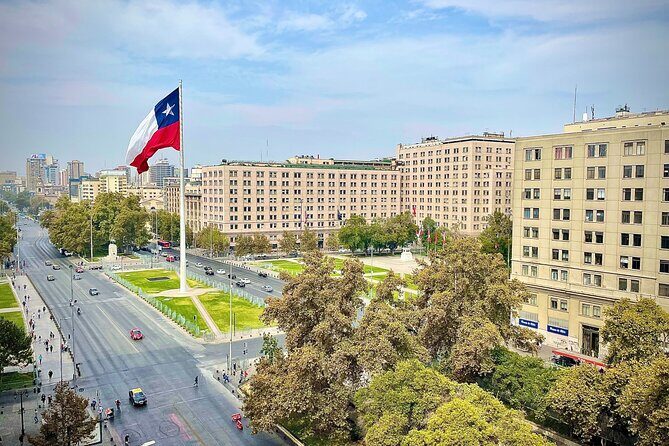
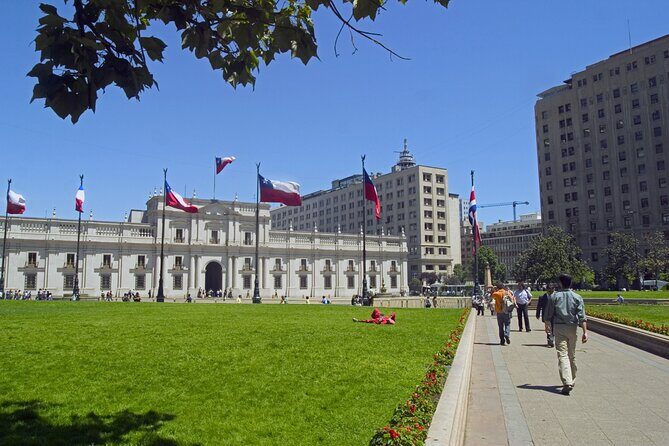
Your first major stop is Centro Cultural Palacio de La Moneda, the executive power headquarters and one of Chile’s most recognizable political symbols. This spot works well early in the day because it sets context. You quickly learn the difference between where political authority sits and where everyday Santiago moves.
Even better: the time here is built in—about an hour—and the admission is free. That means you can take your time looking at the building’s role in national life, without the pressure of rushing through paid attractions.
What to watch for: this area isn’t just architecture. It’s a reminder that modern Chile sits on top of older struggles. A good guide will connect the dots between today’s city and the stories people remember—something guides like Alessandro and Eduardo are specifically known for doing during walks.
Cerro Santa Lucía: the founding hill, plus Monday planning
Next up: Cerro Santa Lucía, the founding place of Santiago and one of the city’s most visited public parks. You’ll get roughly 45 minutes here, with views that help everything else fall into place.
This stop also gives you a change of pace. You move from street-level civic space to a hilltop perspective—exactly what you need before walking deeper into neighborhoods. Admission is free.
One important heads-up: Mondays the hill is closed, and the tour will visit another place instead. If your dates fall on a Monday, don’t worry—you’re still getting your viewpoint moment, but expect a swap in location.
Plaza de Armas and the Metropolitan Cathedral scene-setting
Plaza de Armas is the historic center’s core. Here, you’re not just looking at buildings—you’re watching Santiago run. It’s the kind of place where the city’s rhythm is visible: where people pass through, where the skyline anchors itself, and where major landmarks keep their hold on the street.
You’ll spend about an hour, and admission is free. This is enough time to take in the Metropolitan Cathedral and absorb why this square matters. It’s often the place where first-time visitors start to feel oriented, because the surrounding streets start to make sense once you understand the center.
If you’re the type who likes asking questions, this is a good moment. In multiple guide experiences, the strongest moments come from explaining how architecture and politics overlap—plus how Chile’s history shows up in everyday behavior.
You can also read our reviews of more private tours in Santiago





Santiago Central Market: seafood reality check, not a tourist theater
Then you head to Santiago Central Market for about 15 minutes. This is a traditional fish and seafood market, and it has that unmistakable energy of real trade: activity, smells, and the “fresh today” feel.
Admission is free here too, so you’re paying mostly with your time and attention. Because the stop is short, treat it like a quick orientation to local food culture rather than a full-on meal plan. Use the moment to notice how vendors work and what types of seafood are prominent.
Practical move: if you eat impulsively everywhere, you can end up too full for the later neighborhood snacks and lunch options. If you want the full experience, let this be your look-and-smell stop—then save your appetite.
Barrio Lastarria: artsy streets where you can breathe
Barrio Lastarria is next, roughly 20 minutes. Think cultural life, crafts, painting, antiques, and that artsy neighborhood feel that contrasts with the political and historic core. It’s a nice reset mid-tour—less “monument” and more “people wandering with purpose.”
Admission is free, so you can keep it flexible. If you spot something you want to come back for, this is where your guide’s personalized recommendations start paying off. Many guides are good at pointing out exactly what’s worth your time if you want souvenirs that feel local rather than generic.
If you’re walking with kids or you’re tired, this section is also a good place to slow down and do less rushing. The atmosphere is easier here, and it helps the pace feel human.
Bellavista lunch stop, empanadas, and Neruda’s La Chascona connection
Bellavista is the bohemian neighborhood that sits at the foot of San Cristobal hill. You’ll spend about an hour here, with a stop at a typical Chilean food restaurant for lunch. The key detail: lunch itself isn’t included, but you’ll be set up to eat like a local without having to hunt.
This is also where the tour’s food focus lands. One highlight is sampling a classic Chilean snack of an empanada. In practice, that means you get at least one real taste experience instead of just sightseeing.
A clever bonus comes after: you walk before the facade of the House—La Chascona Museum, Pablo Neruda’s residence. You’re not going deep inside from what’s described; you’re getting the street-level connection. That still counts, because Neruda is part of Chilean cultural identity, and Bellavista is a natural stage for that.
Finally, you reach the bottom of the hill—another small “finish line” moment that makes the walking feel purposeful instead of random.
Patio Bellavista: crafts, copper, alpaca, and souvenir strategy
You end with Patio Bellavista, about 30 minutes. This boulevard is where tourist and gastronomic activities converge, and it’s also a shopping zone for typical Chilean crafts—copper, alpaca items, woodwork, and lapislazuli pieces show up in the mix.
This final stretch is ideal for turning your tour into a shopping plan. Use the time to compare, ask questions, and decide what’s worth carrying home. If you’re buying gifts, I find it helps to think in categories: one wearable (like alpaca), one decorative (like copper or stone), and one small edible option if it’s allowed and fits your travel days.
Admission is free, so you’re paying attention, not entry fees.
Price and time: does $130 feel fair for what you get?
At $130 per person for about 5 hours, the value comes from what’s included and what’s not. You get a professional guide, bottled water, and a included soda/pop natural juice or café. You also get hotel pickup and drop-off, which in a city like Santiago is not a small thing. And a bunch of the key stops have free admission.
What you don’t get: private transportation and lunch. That’s the trade-off. This is built around walking and public transit guidance. If you like the idea of learning by moving—rather than being chauffeured point-to-point—this structure makes sense.
Think of it this way: you’re paying for a human translator of the city. A good guide can save you hours of indecision, point you to neighborhoods worth revisiting, and help you understand what you’re seeing—especially around politics and older Santiago streets.
Who this tour suits best (and what to wear)
This private walking tour fits best if you’re:
- Visiting Santiago for the first time and want a clear “map in your head”
- Interested in political context, historic center landmarks, and cultural neighborhoods
- Comfortable with steady walking and some stairs/hill terrain
- Booking something that gives you recommendations for the rest of your days
What to wear: comfortable shoes. One experience specifically mentioned walking over 6 miles, and Cerro Santa Lucía plus hill areas can feel longer than you expect. Dress appropriately because the tour operates in all weather conditions.
If you’re traveling with a service animal, it’s allowed. And while most people can participate, the main “fitness requirement” is the walking pace.
Language note: the guide may be multi-lingual, so it’s smart to confirm what language you’ll get when booking.
Should you book this Santiago private walking tour?
I’d book it if you want a confident first half-day in Santiago—one that mixes landmark context with neighborhood texture and gives you food and local-shopping time. The biggest strength is the order of operations: you start with the city’s power center, then you work through the historic heart, and finally you finish in the neighborhoods where Santiago’s vibe shows up.
Skip it (or consider a shorter option) if you hate walking or you’re expecting lots of paid museum time. This tour’s main value is interpretation and getting you oriented, not a high-volume checklist of ticketed attractions.
If you’re on the fence, here’s my practical rule: if your next days depend on where to go and what to prioritize, this kind of guided route is a smart way to set your plan.
FAQ
How long is the Santiago private walking tour?
It lasts about 5 hours.
What is the price per person?
The price is $130.00 per person.
What’s included, and what do I pay for myself?
Included are bottled water, a professional guide, hotel pickup and drop-off, and a soda/pop natural juice or café. Lunch is not included.
Does the tour include food?
Yes, you’ll sample a classic Chilean snack of an empanada. You’ll also stop at a typical Chilean restaurant in Bellavista for lunch, but you’ll pay for lunch yourself.
What happens if I’m booking on a Monday?
On Mondays, Cerro Santa Lucía is closed, and the tour visits another place instead.
Is cancellation free?
Yes. You can cancel up to 24 hours in advance for a full refund.